
What Cloud County Property Tax Records Contain
Cloud County property tax records tell one story in three places. The Appraiser sets the value. The Treasurer sends the statement, collects payment, and tracks anything overdue. The Clerk keeps mill levies and taxing-unit details. Anyone can search Cloud County property tax records by address or parcel number. The numbers only make sense when the tax year matches across sources. A valuation on the roll is not a bill. Start with the parcel. Follow it from the assessment roll to the tax statement. Check the property number at each step.
| Field | What It Shows | Where |
|---|---|---|
| Appraised value | County estimate made for the January 1 valuation date | Cloud County Appraiser |
| Assessed value | Appraised or use value multiplied by the Kansas assessment rate | Appraiser roll |
| Class and land use | Residential, commercial, vacant, agricultural-use, and related categories | Real Estate Portal |
| Tax statement and status | Installments, due dates, and delinquency information | Cloud County Treasurer |
| Taxing unit and levy | City, school, county, and other levying context | Parcel record and County Clerk |
Kansas builds a tax bill in two steps. Multiply appraised value by the assessment rate to get assessed value. Then multiply assessed value by the mill levy. Divide by 1,000 to get the tax. The rates differ by property type. Residential property carries an 11.5 percent rate. Vacant lots carry 12 percent. Commercial or industrial property carries 25 percent. Agricultural land is assessed at 30 percent of use value. None of these figures state a sale price. A deed may carry transfer details. The annual assessment and the Treasurer's statement each answer separate questions about the same parcel.
Cloud County's January 1 Valuation Cycle
The Cloud County Appraiser inventories property, inspects and remeasures real property at least once every six years, and revalues property annually. Each year's value speaks as of January 1. The county normally sends valuation notices by March 1, holds the informal equalization process during spring, and certifies the roll on June 1. A portal value and a Treasurer statement may therefore label different tax years.
| Calendar point | Cloud County tax-record event |
|---|---|
| January 1 | Real property valuation date |
| By March 1 | Real-property valuation notices normally mailed |
| Within 30 days | Equalization appeal period after notice |
| June 1 | Appraiser certifies the roll |
| Early or mid-November | Treasurer mails tax statements |
Record the valuation year, the tax year, and the date of any lookup. The public portal displays a database update timestamp, but Cloud County publishes no fixed refresh schedule.
Note: A live timestamp shows recency, not a promise that every deed, split, or value change has posted.
Search Cloud County Assessments With Precise Fields
The free Cloud County Real Estate Portal works with broad or narrow criteria. Pick “Continue as Public User,” open a category, fill in any optional fields. Then select Search. Address pieces help when punctuation or a road suffix blocks a full-address match. A property number or quick-reference number holds up better than an owner's spelling.
| Portal field | Useful tax-record purpose | Format note |
|---|---|---|
| Owner name | Find parcels on the assessment roll | Any portion of the name |
| Full Address | Open the parcel tied to a situs | Can be split into street number, direction, name, suffix, and ZIP |
| Property # / Quick Reference # | Return to a known tax parcel | Entire property ID or its starting portion; quick references include R1545 |
| Appraised Value minimum / maximum | Filter the roll by value band | Currency fields |
| Property Class / LBCS Function | Separate classes and uses | Dropdown categories |
| Acreage / Soil Unit / Land Use | Inspect agricultural valuation context | Land-use options include DR, IR, NG, and TG |
The Appraiser's parcel-search landing page links the parcel, tax, and GIS routes in one spot. It serves as the fallback whenever a bookmarked portal address shifts. The Appraiser office at 811 Washington in Concordia can also help by phone at 785-243-8100.
Turn Appraised Value Into Cloud County Assessed Value
- Appraised value
- The county's estimate under Kansas valuation rules; it is not automatically a sale price.
- Assessed value
- The taxable base after the relevant statutory assessment rate is applied.
- Mill levy
- Tax per $1,000 of assessed value, assembled from the applicable taxing units.
- Tax lien
- The public claim that follows unpaid property tax and may eventually support foreclosure.
The Kansas Department of Revenue's example uses a $200,000 appraised value. It applies the 11.5 percent residential rate. That yields $23,000 in assessed value before the levy. Agricultural land works differently. Soil and land-use categories such as dry land, irrigated land, native grass, and tame grass drive its use value. A direct comparison with a residential fair-market figure misleads. The Appraiser sets value; taxing agencies set budgets and levies.
Three different numbers. Appraised value estimates the property, assessed value is the taxable base, and the tax statement applies the levy. None is necessarily the last sale price.
When Cloud County Tax Bills Arrive and Come Due
The Cloud County Treasurer's tax information page says statements go out in early or mid-November. First-half payment is due December 20 and the second half May 10. Miss a date and interest follows. Treasurer hours run 8:00 a.m. to 4:00 p.m. General courthouse hours extend to 4:30, so confirm before a counter visit. The Treasurer's official page is the direct source for bill timing. It also covers delinquency publication and tax-foreclosure routing.
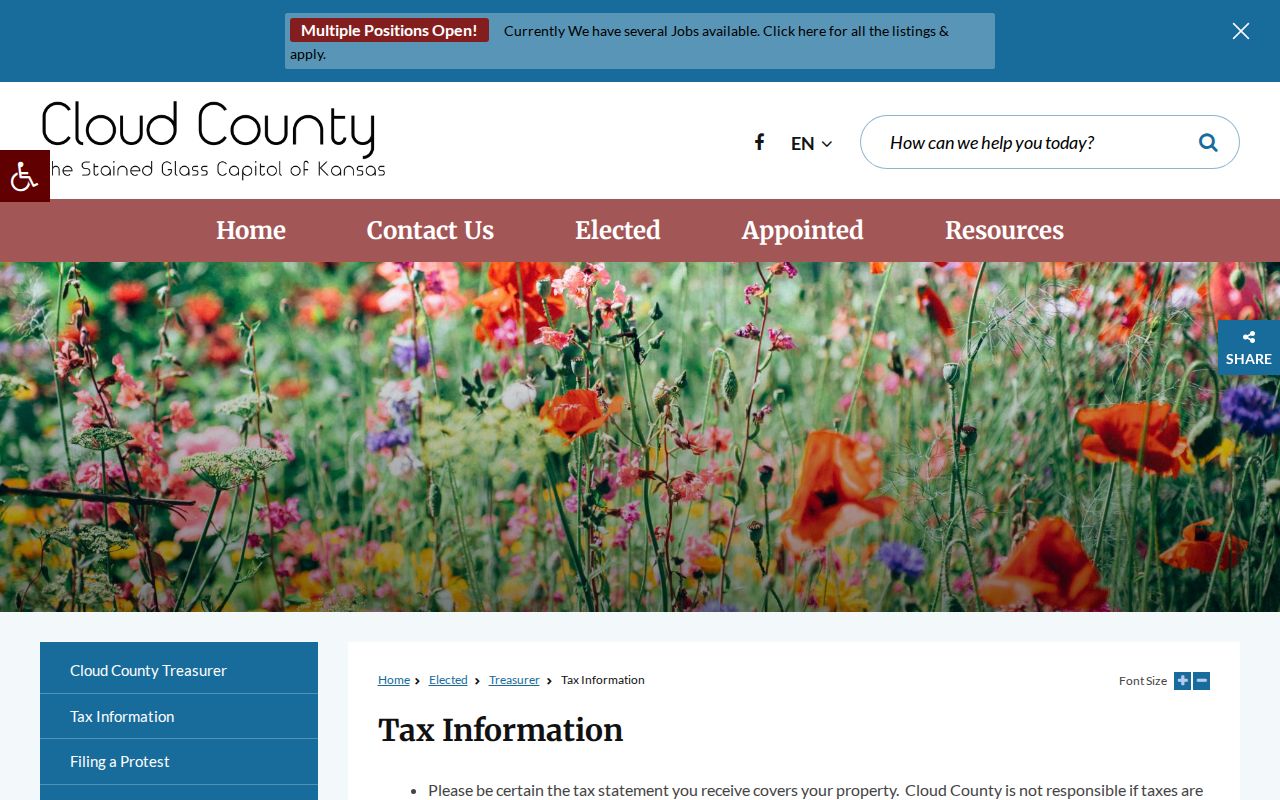
Date the payment schedule from the Treasurer's current wording before acting on any statement. Cloud County property tax records can be reached online, at the Treasurer counter, or by contacting the office when the payment screen cannot locate a statement. The statewide gateway is a payment route, nothing more. It does not replace the parcel roll. Keep the statement, parcel number, payment confirmation, and tax year together so the office can tell the bill apart from a similarly addressed parcel.
The Kansas Gateway Needs a Cloud County Statement
Start at the official Kansas property-tax payment gateway. Select Cloud County, and follow the tax-statement route. The gateway offers no anonymous parcel-result page. An address alone will not surface a bill. It may ask for information printed on a statement, so get that information from the Treasurer rather than trying unrelated commercial search sites. The gateway shows why county selection and the statement belong at the front of any payment search.
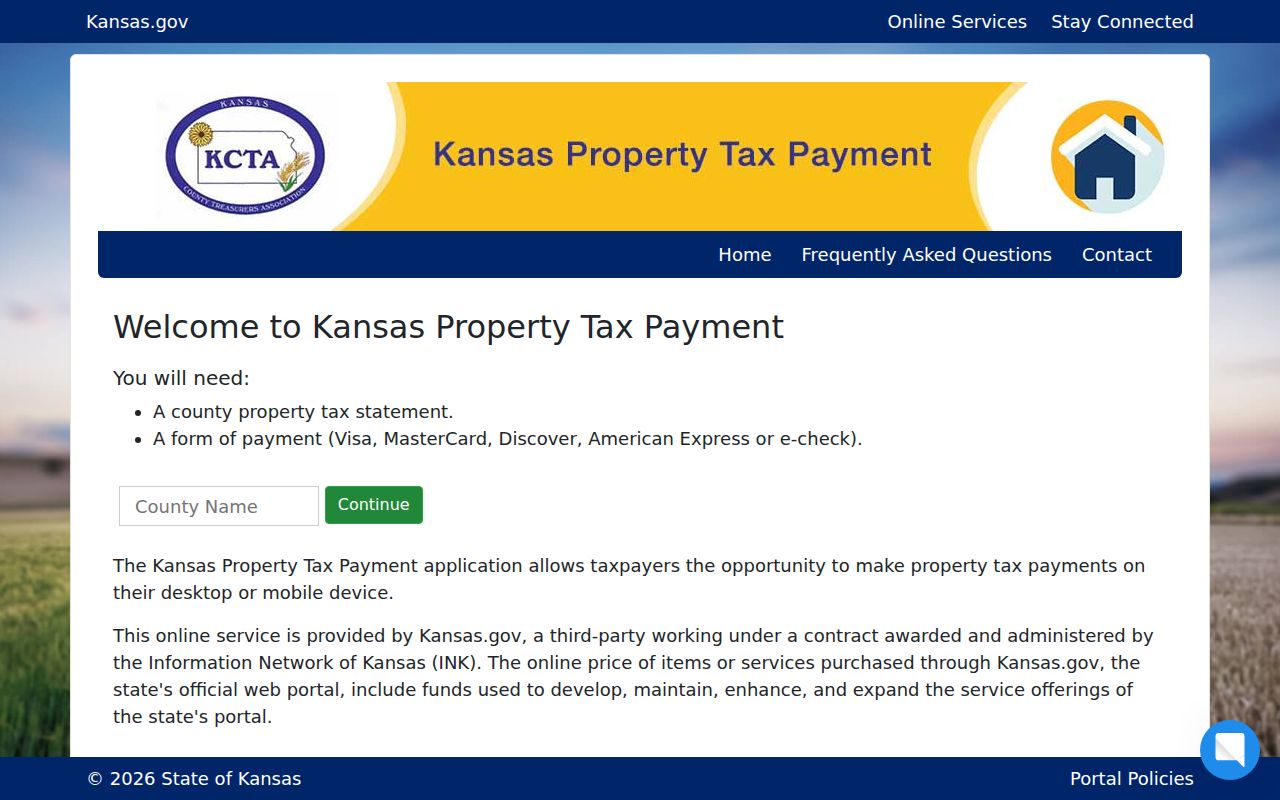
This screen connects payment to the official Kansas route, while assessment detail stays with the Cloud County Appraiser.
Note: Confirm the domain before entering payment information; unsolicited tax links are not a reliable route to a Cloud County bill.
Follow a Cloud County Tax Bill From Parcel to Payment
Keep two offices straight and a Cloud County tax bill gets easier. The Appraiser sets the value, and the Treasurer collects the payment. Start with the situs address or parcel number. Check the year and classification against the Appraiser's tax roll before you pay a single dollar. Then confirm the amount on the Treasurer's tax bill and use the official payment route. If an address will not match, split it into its portal components or pull the PID from the county GIS map.
- Search the Real Estate Portal by situs address, owner, property number, or quick-reference ID.
- Write down the property number, taxing unit, classification, appraised value, assessed year, and portal date.
- Match those identifiers to the Treasurer statement and check which installment and year the payment concerns.
- Use the Kansas gateway only after confirming Cloud County and the statement details; retain the receipt.
- For a dispute, distinguish a valuation appeal from a payment-under-protest filing and follow the matching deadline.
- Assessment roll
- The Appraiser's annual parcel-and-value record.
- Tax statement
- The Treasurer's bill for the applicable property and year.
- Payment under protest
- A specific procedure that requires payment and a signed county form.
- Taxing unit
- The combination of public bodies whose levies apply to the parcel.
Cloud County Delinquency Moves From Publication to Court
Real-estate taxes still unpaid on August 1 appear in the official county newspaper for three straight weeks that month. The publication falls under K.S.A. 79-2301 through 79-2323a. Four years of delinquency allows the county to file a tax-foreclosure suit and move the parcel to public auction. A delinquent owner cannot bid. The newspaper listing signals a problem worth investigating. It does not mean an auction has already taken place.
For the account itself, the Cloud County Treasurer is the first stop. A filed foreclosure shows up in the Kansas District Court CaseSearch or through Cloud County District Court. The Register of Deeds may hold related liens or the instruments that follow a sale. Guest case-search results are not certified court records. A tax record alone never settles the final ownership outcome.
Contest a Cloud County Assessment on the Correct Clock
A Cloud County appeal starts with the valuation notice, not the November tax bill. The Cloud County appeal process generally gives the owner 30 days after notice. That window is for requesting an informal meeting. Preparation matters. Bring the parcel record and the property's characteristics. Add comparable-sale evidence, photos, and a plain explanation of the claimed error in the appraisal. After the county issues its decision, the prescribed Board of Tax Appeals route takes over.
Appeal window. A Cloud County equalization appeal generally must begin within 30 days of the valuation notice. Contact the Appraiser promptly because a late valuation challenge is not cured by waiting for the tax bill.
The official appeal page pictured below lays out the informal meeting and decision route.
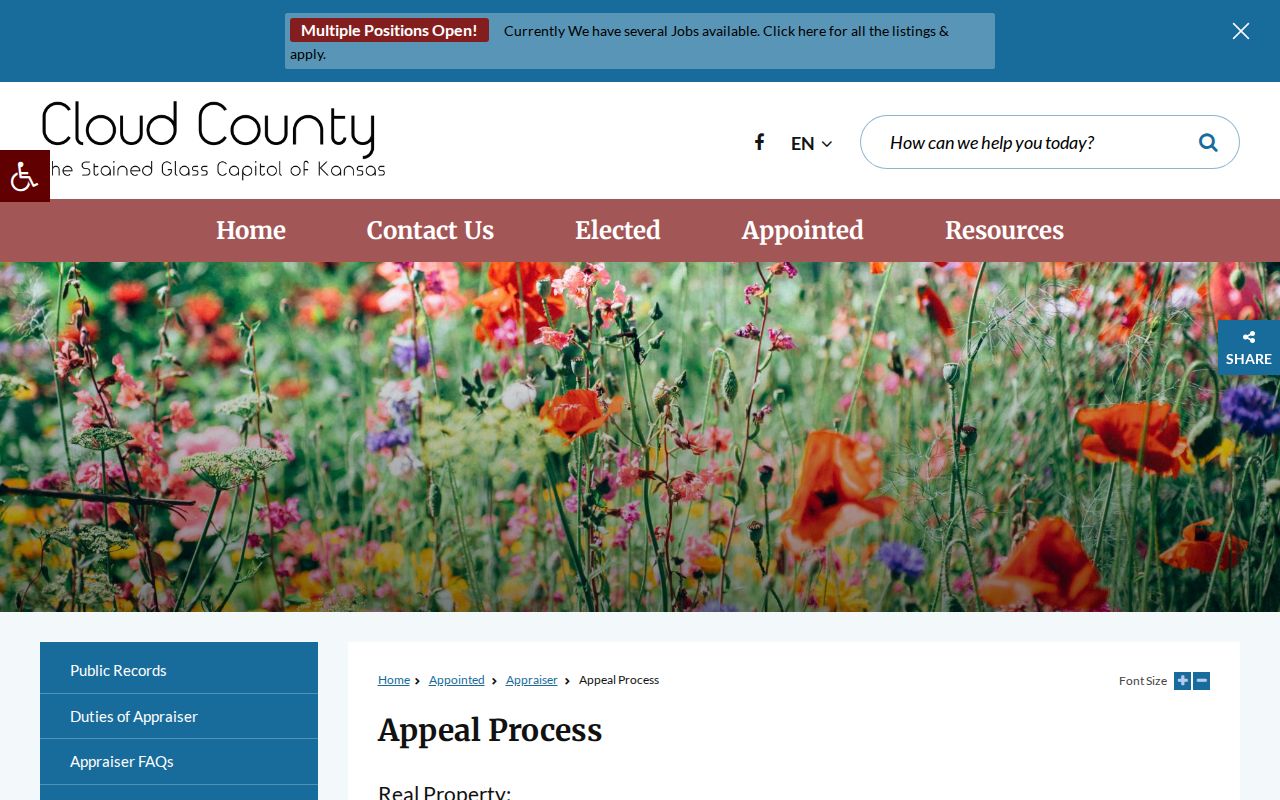
Deadlines shift, so trust the county's current instructions and forms. A date remembered from a prior tax year can cost you the appeal.
A Cloud County Payment Protest Is a Separate Procedure
The payment-under-protest route in Cloud County runs on its own calendar. The taxpayer requests the county form after November 1. The taxpayer pays the tax, signs the filing, and submits it by December 20. When an escrow agent pays, the stated deadline moves to January 31. An unsigned application is invalid. Keep a copy for the Board of Tax Appeals. The county also uses a separate form when a levy is allegedly illegal.
This route is not the spring equalization appeal. Confirm which decision you are disputing before filing anything. The Appraiser handles value and classification. The Treasurer administers the tax-payment protest. A specific question can also go to the office holding the record as a Kansas Open Records Act request. The office may charge reasonable actual costs. It generally responds within three business days or provides an estimate.